

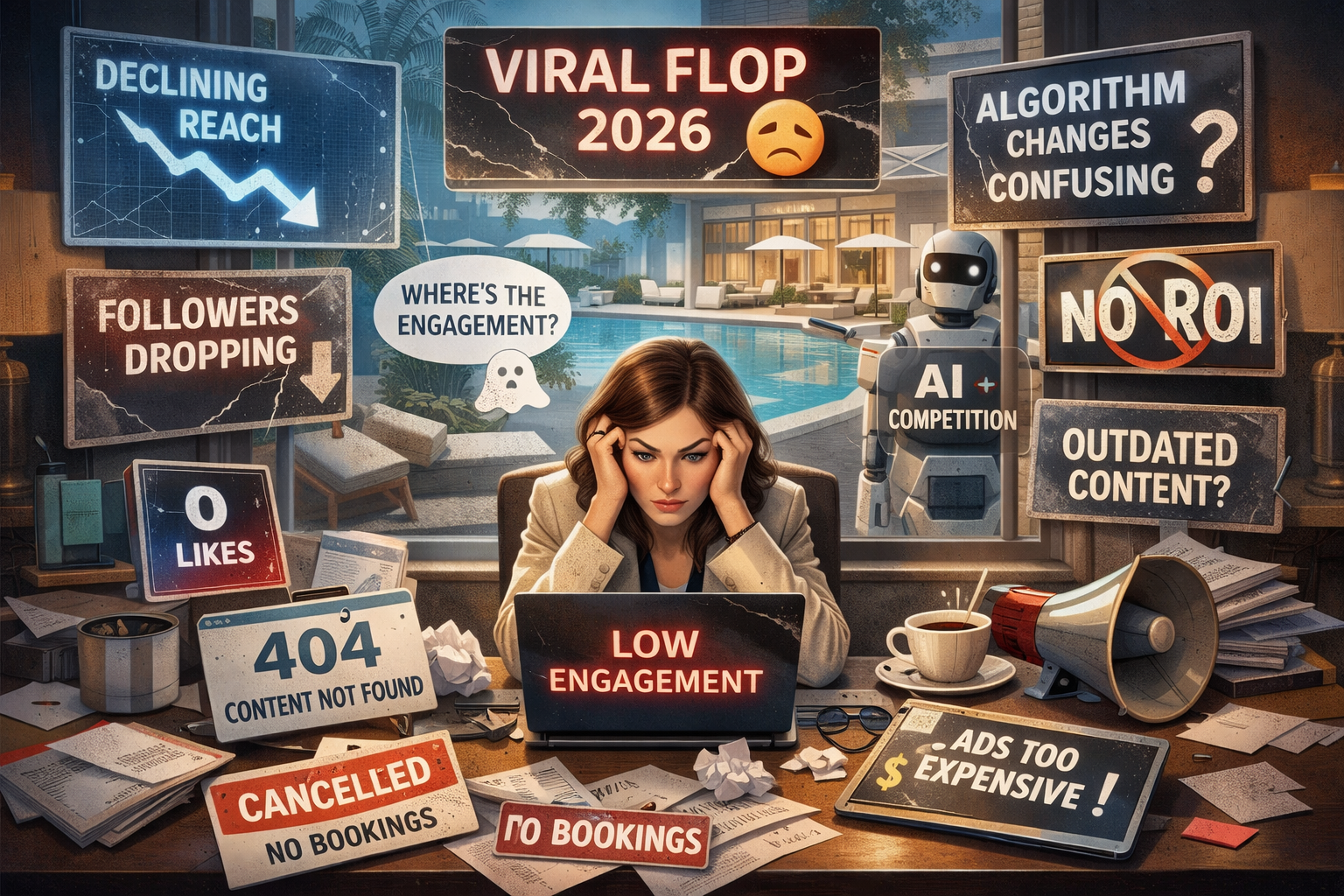
- A Strategic Guide to Boutique Hotel Content Marketing, AI, and Direct Growth
- Boutique hotel owners who once relied on steady direct bookings now face shrinking visibility as OTAs and AI-driven search dominate traveler discovery. In 2026, small teams, limited budgets, and evolving search behavior make content marketing more challenging than ever. With more than half of searches ending without a website click, independent hotels risk losing direct bookings if they fail to adapt.
- The solution is not expanding marketing teams, but modernizing strategy. By auditing existing content, clarifying brand storytelling, and leveraging AI-powered tools, boutique hotels can improve visibility and reduce dependence on OTAs. Many properties have already seen significant gains in direct bookings through smarter digital systems. Treating marketing as core infrastructure—not an afterthought—allows independent hotels to compete effectively and secure long-term growth.
Introduction: The Boutique Hotel Positioning Struggle
Boutique hotels are known for their unique character, not their size. Their charm comes from individuality, history, local culture, and personal guest experiences. However, their online presence often lags behind that of bigger brands.
This gap is one of the main marketing challenges boutique hotels face today.
In 2026, travelers don’t just browse hotel websites. They ask AI assistants for suggestions, check several review sites, and look to travel influencers, short videos, and generative search tools before deciding. Now, people get curated answers instead of scrolling through long lists.
Imagine two boutique hotels in Lisbon: The Alfama Retreat and The Bélem Tranquil. When a traveler asks for a quiet boutique hotel in Lisbon with a freestanding tub and sunset terrace under €300, an AI assistant like HelloShift can review and compare these hotels. It communicates fluently with guests in over 100 languages, according to HelloShift. The Alfama Retreat invested in AI-driven content systems, offering detailed room info, strong SEO, and structured storytelling. It highlights its unique freestanding tubs and scenic sunset views over Alfama’s rooftops. The Bélem Tranquil, however, has outdated content, lacks structured data, and has no customized storytelling.
As a result, the AI assistant recommends The Alfama Retreat, given its clear, compelling content that aligns with the traveler’s query. This not only increases the likelihood of booking but also underscores the importance of modern content strategies. If your hotel’s content is old, inconsistent, or not well organized, it might never show up in those AI recommendations.
This shift creates new marketing challenges. Unlike large chains with extensive digital resources, boutique hotels often have small teams focused on guest service rather than content creation.
Content marketing has changed. Success now requires structured data, SEO, generative engine optimization, consistent storytelling, and regular updates. But these obstacles also bring new opportunities. AI-driven content systems help boutique hotels modernize their marketing while keeping their authentic voice. Nevertheless, it is important to recognize the limitations of relying on AI alone for content creation and distribution. While AI can assist in organizing and optimizing content for discovery, it may struggle to capture the nuanced storytelling and emotional resonance that define a boutique hotel’s unique experience. As a result, human oversight remains essential to ensure authenticity and meaningful engagement. Rather than substituting human storytelling, AI should be viewed as a tool that makes it easier for your property’s story to be found, organized, and matched to how travelers search today.
The following sections cover the five biggest content challenges boutique hotels will face in 2026 and, crucially, how smart operators can address them. As you read, take note of which challenges your property faces—then put the recommendations into practice to overcome them and gain a competitive edge.
Challenge 1: We Need a Big Team
A common myth in boutique hotel marketing is that large teams are needed for effective content creation. In reality, many properties have limited marketing resources. The general manager often juggles operations, staff, complaints, vendors, and revenue, turning marketing into a reactive task. This pressure causes inconsistent content. Websites become outdated, blogs sit for months, social media fluctuates with staff, and email campaigns are irregular. Over time, this inconsistency hurts visibility.
To address these problems, boutique hotels can follow a 90-day content strategy sprint. The approach includes: 1. Week 1: Perform a comprehensive content audit to reveal strengths and gaps. 2. Week 2: Create storyboards with distinct value propositions and story arcs. 3. Week 3: Optimize all content for SEO and GEO for greater visibility. 4. Week 4: Implement AI tools for content creation and management. 5. Week 5: Develop a social media posting calendar to ensure steady engagement. 6. Week 6: Launch targeted email campaigns using customized messages. 7. Weeks 7-9: Monitor analytics to measure performance and refine strategies as needed.
Consider The Willow Inn, a boutique hotel in Greenfield. Lodging Interactive, a national brand managing Extended Stay properties, launched a 90-day plan to improve digital visibility and guest engagement. They began by reviewing their content and highlighting the location’s history. By week two, they created stories that showed the inn’s charm. As weeks progressed, their SEO was refined. Using AI helped create consistent content. FutureStays.ai reported that a Lisbon hotel adopting creative content, such as staff vlogs and Instagram takeovers, saw a 44 percent increase in direct bookings after moving away from standard visuals. Adopting a structured, personality-driven strategy can help boutique hotels be proactive, increase consistency, and gain a stronger online presence.
Search engines and AI platforms see inactivity as stagnation. When content loses appeal, algorithms lower your ranking, and organic traffic drops. This pushes hotels to use last-minute OTA promotions, which cut profits and hand over guest data to third parties. Without structured content planning, marketing stays responsive, not strategic. This shows that good strategy matters more than team size. Smart systems maintain high consistency and visibility.
Why This Is a Core Independent Hotel Marketing Challenge
Boutique hotels often have staff covering many roles, unlike chains, which have dedicated content teams. Agencies can be costly and may miss the property’s unique personality. This is where AI can help.
Services like TypeHero.ai strengthen small teams. Staff don’t need to write and format everything themselves. AI can quickly create blog posts, captions, room descriptions, and guides that stay consistent with your brand voice. For example, AI may draft a room as “a comfortable nest with a modern look.” With human editing, it becomes “an intimate retreat, blending contemporary design with timeless comfort.” This teamwork keeps communication authentic. To get the best from these tools, hotels can train their teams. Upskilling staff reassures hotel owners that small teams can use and benefit from AI-powered strategies.
For example, a single local wine festival can be transformed into:
- A search-optimized blog article.
- A geo-targeted email campaign.
- Instagram captions designed for different audience segments.
- Structured FAQ content for generative search platforms.
AI does not replace creativity; it speeds up execution.
By consistently leveraging AI to support content creation, boutique hotels can maintain their digital profile even during busy periods. Don’t wait for competitors to take the lead—commit to steady improvement, boost visibility, build authority, and reduce the need for last-minute discounts starting today.
Challenge 2: Inconsistent SEO and Generative Visibility
A major challenge is fragmented SEO execution. Many boutique hotels invest in website design but neglect long-term optimization.
Traditional SEO focuses on keyword placement, backlinks, and technical optimization. In 2026, however, generative engine optimization (GEO) has become equally important.
GEO helps your property show up in AI-generated answers, not just in search rankings.
This requires structured data, detailed room attributes, comprehensive FAQs, and clear amenities. AI prefers specifics. Instead of “luxurious rooms,” use more detailed descriptions, such as “soundproofed high-floor rooms with west-facing terraces and ergonomic work desks.” Similarly, rather than listing basic amenities as “pool and gym,” describe them as “a 25-meter heated lap pool with surrounding cabanas and a modern fitness center featuring the latest in cardiovascular and weightlifting equipment,” which paints a clear image. For local experiences, go beyond “city tours” and craft enticing narratives such as “guided walking tours through the historic market district with exclusive visits to artisan workshops and sampling of local delicacies.” These specifics not just enhance your content’s appeal but also ensure optimal alignment with AI-powered recommendations and search engines.
Without structured strategies, properties miss out on both traditional and generative visibility opportunities.
The Shift Toward Answer-Ready Content
Modern travelers use conversational queries and expect instant answers. With zero-click discovery, users may never visit your site if AI summarizes it elsewhere. When was the last time your FAQ page was updated? For example, a boutique hotel might replace the outdated question ‘Do you offer breakfast?’ with a more detailed response: ‘Yes, we offer a complimentary breakfast featuring local pastries, fresh fruit, and organic coffee, served daily from 7:30 to 10:00 AM in the garden courtyard.’ Such specific updates ensure your information appears accurately in AI-generated summaries and maintain your relevance in search results. To stay competitive, boutique hotel marketing needs to move from simple promotional copy to content that is ready to answer travelers’ questions.
This includes:
- Detailed room descriptions.
- Structured FAQs.
- Comprehensive local guides.
- Clear amenity categorization.
- Consistent metadata across platforms.
AI-powered tools identify keywords, track trends, and optimize structured content, all without deep technical knowledge.
By automating SEO tasks, small hotel teams can achieve the same level of visibility as larger companies.
Inconsistent SEO now directly impacts revenue. As generative engines drive discovery, only well-structured properties get recommended.
Challenge 3: Weak Storytelling in a Commoditized Market
Online Travel Agencies present hotels as interchangeable commodities. Price, star rating, and availability dominate the interface, regularly overlooking the unique characteristics that define a boutique hotel. The details of your property’s history, design philosophy, and local integration often get lost. This loss of storytelling depth not only diminishes brand identity but also compromises financial performance. Without a persuasive story, boutique hotels miss out on capturing higher nightly rate premiums, as potential guests are less inclined to pay extra for an experience that seems generic.
For boutique hotels, this trend makes it harder to stand out from the competition.
Strong storytelling is the solution, but teams commonly lack the time and direction to create long-form stories or themed campaigns.
As a result, boutique hotel content strategies frequently become scattered. Stories go untold, unique features are left out, and local partnerships are underused.
This is one of the most overlooked marketing challenges for boutique hotels.
Reclaiming Narrative Authority
Effective content marketing must highlight micro-experiences. The locally sourced honey, hidden courtyard, or preserved heritage staircase create emotional differentiation. One guest review encapsulated this beautifully, stating, ‘The moment you taste their honey straight from local hives while sitting in the sun-dappled courtyard, you know you’ve found a hidden gem.’ These genuine guest experiences enhance storytelling authenticity and draw prospective travelers in.
AI tools analyze guest reviews for frequent themes and emotional triggers, such as “calm atmosphere” or “sunset terrace views.” These can become anchors for future stories.
AI enables properties to create campaigns rooted in guest sentiment rather than generic promotions.
This approach develops direct engagement and creates a strong brand position that OTAs cannot copy.
In a market where travelers increasingly prioritize authentic experiences, structured storytelling is no longer optional. It is strategic insulation against commoditization.
Challenge 4: Lack of Personalization
Personalization expectations have risen sharply in recent years. Today’s travelers expect hotels to understand their preferences, travel purpose, and past booking behavior. However, many boutique hotels still rely on generic email campaigns because they lack advanced segmentation tools or the time to manage detailed audience targeting. This gap between what guests expect and what they receive can weaken engagement and long-term loyalty.
For example, a solo business traveler receiving a “family getaway” promotion immediately feels the disconnect. A couple who previously booked a romantic suite may later receive conference package offers that feel irrelevant. These repeated mismatches reduce open rates, lower click-through rates, and gradually affect brand perception. Guests may not complain—but they begin to disengage.
While personalization is central to modern boutique hotel marketing, executing it manually requires reviewing guest data, creating meaningful segments, and crafting tailored messages for each group. For small teams managing social media, OTA updates, and daily operations, this process can quickly become overwhelming. Without scalable systems in place, personalization remains an intention rather than a consistent strategy.
From Segmentation to Predictive Personalization
AI systems examine first-party data to identify behavioral patterns and preferences, allowing boutique hotels to create highly targeted marketing segments. Guests who book midweek stays, for example, may respond to “workation” offers, which can be labeled as the ‘Weekday Warriors’ segment. Couples who previously booked anniversary packages can be grouped as ‘Anniversary Aficionados,’ while families might be targeted with seasonal or local experience packages. These intuitive, clearly defined segments make personalization actionable and manageable for small marketing teams.
Rather than sending identical emails to the entire guest list, hotels can now deploy tailored landing pages, personalized email sequences, and dynamic website content that speaks directly to each segment. AI tools can even adjust messaging based on a guest’s engagement history, ensuring that promotions and recommendations feel timely and relevant. For small boutique hotel teams, this level of precision in content marketing was previously impossible, given the time and resource constraints.
By automating content creation and aligning messaging with guest intent, AI not only simplifies the marketing workflow but also ensures consistency and relevance across all channels. The benefits extend beyond operational efficiency—hotels experience higher open rates, stronger engagement, improved conversion rates, and more direct bookings, all without expanding staff. This intelligent personalization allows boutique hotels to deliver the high-touch, memorable experiences guests expect, both online and on-property, strengthening loyalty and enhancing overall brand perception.
Challenge 5: Excessive Dependence on OTAs
OTA dependence remains one of the most pressing independent hotel marketing challenges in 2026. For boutique hotels, these third-party platforms offer immediate visibility and booking volume, but they come at a steep cost. Commission rates typically range between 15–30%, eroding profits on each reservation and putting pressure on already tight operating budgets. While OTAs can help fill rooms quickly, this short-term gain often masks the long-term strategic risks that arise from overreliance on intermediaries. Beyond the financial burden, the greater challenge lies in the loss of control over guest data. When a booking is made through a third-party platform, the hotel does not gain full access to critical behavioral insights. These data gaps prevent properties from understanding their guests’ preferences, booking patterns, and engagement with offers, making it difficult to create personalized experiences or targeted marketing campaigns.
Over time, this creates a vicious cycle of dependency. Lower direct visibility reduces the property’s ability to attract guests organically, which in turn increases reliance on OTAs to maintain occupancy levels. As boutique hotels continue to depend on these platforms, their brand independence diminishes, and the hotel’s own digital channels—website, social media, and email marketing—are often neglected. The result is a weakening of brand recognition and a reduction in long-term guest loyalty, as the hotel becomes just another listing in a crowded marketplace where price and availability, rather than unique experience, dominate decision-making.
Breaking this cycle requires a proactive and strategic approach to boutique hotel content marketing. Hotels must prioritize building their own digital presence and cultivating direct relationships with guests. This begins with creating compelling, informative, and authentic content that tells the property’s story, highlights unique experiences, and captures the essence of the local environment. High-quality content is no longer optional; it is a competitive necessity. When optimized for search engines, AI-driven platforms, and generative search, this content ensures that guests discover the property through channels the hotel controls rather than relying on OTAs for exposure.
AI-powered tools play a crucial role in reclaiming this independence. By automating content generation, streamlining social media posting, and tailoring messaging to guest segments, boutique hotels can attract direct bookings without overburdening small teams. Personalized communications, dynamic website updates, and targeted campaigns make the hotel’s own platform more attractive than third-party sites. Guests are increasingly drawn to booking directly when they feel the experience is customized and authentic, rather than transactional.
In addition to driving direct bookings, strategic content marketing helps hotels regain ownership of guest data. By capturing behavioral insights, preferences, and engagement metrics, properties can continuously refine their offerings, improving both marketing effectiveness and the guest experience. Over time, this strengthens brand loyalty, reduces dependence on OTAs, and increases overall profitability. Breaking free from OTA reliance is not a single action—it is a sustained commitment to building a hotel’s digital ecosystem, harnessing AI, and telling the property’s unique story to the right audience at the right time. For boutique hotels that successfully execute this strategy, the rewards are substantial: higher margins, greater independence, stronger guest relationships, and a more resilient brand capable of thriving even in a highly competitive marketplace.
Strengthening Direct Booking Infrastructure
When a hotel’s website provides richer, more informative, and customized experiences than OTA listings, guests are more likely to book directly.
AI supports this shift by:
- Enhancing SEO and GEO visibility.
- Improving website content structure.
- Personalizing booking journeys.
- Automating chat-based assistance.
- Optimizing channel allocation strategies.
As direct booking rates increase, hotels regain control over revenue and guest relationships. Reducing OTA dependence does not mean leaving these platforms completely. It entails adjusting your distribution channels to focus on profit and long-term guest loyalty.
Strategic Outlook: The Future of Boutique Hotel Marketing
Boutique hotels maintain creativity while working with limited resources. Their individuality is their biggest strength, but only if people can see it.
In 2026, digital visibility relies on structured, consistent, and smart content systems. AI does not replace hospitality; it helps protect it.
In summary, the future of boutique hotel content marketing lies in leveraging automation, targeted optimization, and personalized communication to maximize operational efficiency, control digital visibility, and foster guest loyalty, all through the delivery of strategic content tailored to evolving traveler search behaviors.
Hotels that adopt this approach won’t just survive changing marketing challenges; they’ll thrive. They will lead a new era of independent hospitality, where genuineness and smart systems work together.